Reframing Global Security at the United Nations: An Indigenous Fijian Woman's Perspective on Nuclear Doctrine and the Pacific Challenge
- Collaborator
- Feb 15
- 7 min read
Updated: Feb 25
By Merewalesi Tuilau
Security at the United Nations is often presented as neutral and technical-defined through doctrines of deterrence, institutional mandates, and strategic balance. Yet for Indigenous Pacific peoples, particularly Indigenous Fijian women, security is profoundly lived: through the legacies of nuclear testing, environmental contamination, militarisation, climate displacement, and exclusion from the very decision-making tables that shape our futures.
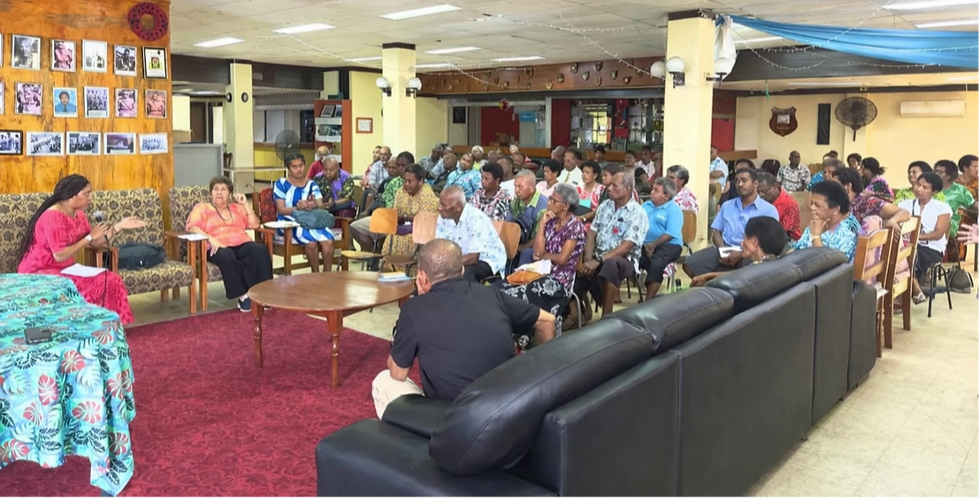
For Indigenous Fijian Women, security has never been abstract or distant. It is relational-rooted in care for land, ocean, bodies and future generations. Nuclear doctrine erases this understanding, replacing it with strategic distance and acceptable sacrifice.
This piece interrogates how nuclear-armed states define security and peace across key policy frameworks, exposing their incompatibility with human and planetary survival in the 21st century. From a Pacific viewpoint, these frameworks have long justified sacrificing colonized and Indigenous territories for "greater stability." The Treaty on the Prohibition of Nuclear Weapons (TPNW)—championed by non-nuclear states, including many from the Global South and Pacific—offers a vital corrective: a paradigm centered on survival, justice, healing and intergenerational responsibility.
Dominant State Definitions of Security and Peace
Armed States | Definition of Security | Definition of Peace |
United States | Security is maintained through military superiority, global force projection, alliances (e.g. NATO), and nuclear deterrence to protect national interests and the “rules-based international order.” | Peace is stability achieved through deterrence and dominance—preventing war by maintaining overwhelming military and nuclear capability. |
Russia | Security is the protection of sovereignty and regime stability against external threats, especially NATO expansion, through strategic nuclear forces and military strength. | Peace is achieved through strategic balance and fear of escalation—where adversaries are deterred from challenging Russian power. deterrence—where overwhelming capability discourages annihilation attempts. |
China | Security is safeguarding territorial integrity, political unity, and long-term national development, supported by a minimum but credible nuclear deterrent. | Peace is stability ensured through balance, non-interference rhetoric, and deterrence—while reserving force for “core interests.” |
United Kingdom | Security is national survival and alliance credibility, maintained through an independent nuclear deterrent (Trident) integrated into NATO strategy. | Peace is sustained by deterrence and collective defence—nuclear weapons are framed as preventing existential threats. |
France | Security is strategic autonomy and protection of national sovereignty through an independent nuclear force (“force de frappe”). | Peace is deterrence-based stability, where nuclear capability guarantees freedom from coercion by other powers. |
India | Security is protection from regional threats, especially Pakistan and China, through credible minimum deterrence and conventional military strength. | Peace is regional stability maintained by deterrence and strategic restraint—conditional and fragile. |
Pakistan | Security is national survival and balance against India, with nuclear weapons seen as equalising asymmetry. | Peace is deterrence-driven stability—where nuclear capability prevents conventional or existential defeat. |
Israel (undeclared but widely acknowledged)
| Security is existential survival in a hostile regional environment, ensured through military superiority and nuclear ambiguity. | Peace is strength-based deterrence—where overwhelming capability discourages annihilation attempts.
|
North Korea (DPRK)
| Security is regime survival against perceived external aggression, guaranteed by nuclear weapons and missile capability.
| Peace is deterrence through fear—where nuclear capacity prevents invasion or regime change.
|
State / National Security
Nuclear-armed states prioritize sovereignty, territorial integrity, and geopolitical influence. Peace means the absence of major interstate war among powers, with stability—not justice—as the goal. Historically, this logic legitimized using colonized Pacific lands as testing grounds or strategic sacrifice zones.
Military and Strategic Security
Deterrence through overwhelming capability, including nuclear force projection, is equated with safety. Peace is enforced by making conflict costs unbearable. While proponents argue this has prevented great-power war since 1945, it normalizes the perpetual threat of escalation, accidental launch, or proliferation—risks that disproportionately burden peripheral regions.
Nuclear (Strategic) Security
Nuclear weapons are framed as guarantors of stability via mutual vulnerability and second-strike assurance. Humanitarian and environmental consequences are rhetorically noted but excluded from core calculations, despite scientific evidence of catastrophic harm. Peace here is strategic balance, not human safety.
Human and Environmental Security
UN frameworks increasingly reference individual protection and climate risk, yet both remain subordinate to state and military priorities. Peace is reduced to social order and governance, often without addressing structural injustice, historical harm, or the need for healing and repair. Climate change is now framed as a “threat multiplier,” yet nuclear weapons’ environmental legacy—long-term radiation contamination, ecosystem destruction, and food-chain poisoning—is rarely treated as a security threat within defense policy. This omission is glaring in the Pacific, where fallout from U.S. tests (including the 1954 Castle Bravo explosion at Bikini Atoll) and French atmospheric and underground tests at Moruroa (1966–1996) continues to shape health, land use, and regional trust.

The Pacific as a Nuclear Sacrifice Zone: The Case of Christmas Island
A stark example is the United Kingdom’s Operation Grapple nuclear tests (1957–1958) on Christmas Island (Kiritimati), where more than 300 Fijian soldiers were deployed as part of British forces. These men were exposed to nuclear detonations with little more than standard military uniforms, ordered to witness blasts at close range, and tasked with handling contaminated wildlife and radioactive waste—often disposed of directly into the ocean. Protective equipment was absent. Risk disclosure was minimal. The consequences were delayed—but devastating.
Veteran Nacanieli Seru, of the Fiji Nuclear Veterans Association recalled during a speaking panel at the Pacific Islands Forum on the International Day Against Nuclear Tests in 2023:
“We were informed that we were embarking on a mission to Christmas Island, with the purpose of witnessing the detonation of a hydrogen bomb…we were gathered and instructed to sit along the shoreline, facing the sea, before the bomb’s detonation. Later, we were told to turn away from the sea, shielding our eyes as the bomb exploded.”
Intergenerational health impacts—including cancers, blood disorders, and hereditary illness—remain unresolved. In 2015, the Fijian government issued one-off grants to 24 surviving veterans to address medical and welfare needs, implicitly acknowledging the UK’s failure to fulfill its obligations. These testimonies reveal how “strategic” decisions translate into enduring harm on Pacific bodies, families, and futures.
In 2015, Veteran Naibuka Naicegulevu, 76 years’ old then shared his experience during the compensation ceremony held by the Fijian government for veterans exposed to British nuclear testings’ in 1957 and 1958:
“We were only told that we will go there to test some weapons, but when we got there we found out that we were brought there to be part of the British test of weapons of mass destruction…my two sons, now in their early 30s get sick suddenly and they can be ill for one week, sometimes more, this is all because of the radiation that we were exposed to.”

Economic Security
Growth, trade, and defense industries (including nuclear modernization) drive priorities. Peace is economic predictability, even as vast resources divert from health, climate adaptation, and reparative justice in vulnerable areas.
The TPNW: A Competing Paradigm from the Pacific and Global South
The TPNW, adopted in 2017 and in force since 2021, directly challenges this order. As of late January 2026, it has 74 states parties and 95 signatories, with strong Pacific leadership—Fiji ratified in 2020, joining others like Cook Islands, Kiribati, Nauru, Samoa, Solomon Islands, Tuvalu, and Vanuatu. It reframes security as:
· Human-centered and grounded in lived harm
· Environmentally protective and intergenerational
· Collective and legally/morally constrained by humanitarian, human rights, and environmental law
From an Indigenous Fijian perspective, security is inseparable from land, ocean, and future generations. Peace requires eliminating—not managing—existential threats. The TPNW aligns with longstanding Pacific efforts, including the 1985 Treaty of Rarotonga (South Pacific Nuclear Free Zone), which Fiji helped pioneer.

Pathways for Effective Disarmament and Non-Proliferation
Progress demands structural change beyond symbolic gestures:
· Center affected communities—Indigenous peoples, nuclear survivors (like Fiji's Christmas Island veterans), and women—in implementation, victim assistance, and environmental remediation.
· Treat nuclear weapons as humanitarian and environmental threats, not just strategic assets.
· Redirect military spending toward climate resilience, health, and reparative justice.
· Strengthen nuclear-free zones like the South Pacific as models of cooperative security.
· Build global stigma against nuclear weapons, mirroring successes with chemical and biological arms.
The TPNW complements existing disarmament frameworks. Normative pressure from those who have borne the highest costs—not from nuclear-armed states alone—will be the primary driver of change.

Security for Whom?
Nuclear-armed states claim their weapons preserve peace. Indigenous Pacific communities know these weapons were tested on our lands, oceans, and bodies—without consent, accountability, or full remediation. The testimonies of Fiji’s Christmas Island veterans make this painfully clear.
This is not idealism versus realism. It is a question of power: whose security defines the global order?
For diplomats, defence planners, and United Nations member states, the question is unavoidable: if global peace rests on the permanent threat of mass civilian annihilation, can the UN credibly uphold human dignity and international law?. And if those most harmed by nuclear weapons—Indigenous Pacific peoples and other affected communities—are leading the abolition movement, what does continued resistance to the TPNW reveal about privilege, power, and whose lives are deemed expendable?
The Pacific challenge is clear: reframe security around survival and justice, or risk rendering “peace” meaningless for those who continue to pay its price.
If this blog piece has inspired you to share a traditional, cultural creative piece or opinion piece in connection to the subject matter, comment below collaborate! Or contact us directly, and don't forget to click follow on our social media pages for the latest blog updates.
About the Collaborator:
Merewalesi Tuilau serves as the United Liberation Movement for West Papua Fiji Head of Mission and is an expert for Nuclear Weapons with ICAN International. She is proudly from Tubalevu village, Namara, Tailevu with maternal links to Tavuki village, Tavuki, Kadavu. In her free time, she bakes and is a rourou gatherer.


Comments